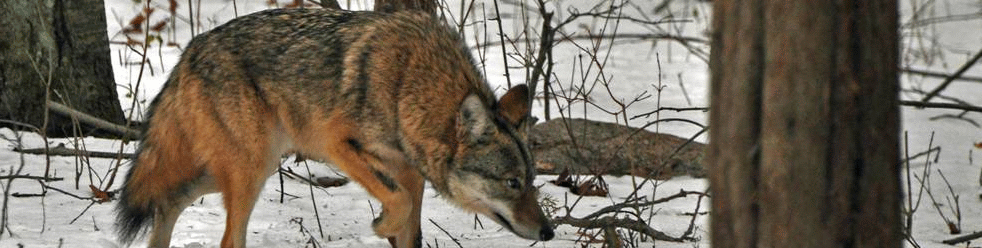
The Eastern Coyote or Coywolf is a variant of the western coyote (Canis latrans) that hybridized with eastern (Canis lycaon) and red (Canis rufus) wolves when coyotes migrated east during the early and mid-twentieth century. Eastern coyotes/coywolves are the large canine species that now resides in the northeastern US in almost all habitats.
Eastern Coyote / Coywolf Information:
- Coyote Ecology
- Coyote Morphology
- Living With Coyotes
- History of Coyotes & Wolves in the Northeastern US
- Eastern Coyote Resources
A list of blog articles about coyotes is on our coyote resource page.

I find coyotes completely fascinating. They are smart, beautiful, clever and yes, wily. I can’t put my finger on the moment my intrigue of, and respect for them really blossomed, but I know that by the time I had finished Hope Ryden’s book God’s Dog in 1998 I was hooked. When I entered Antioch University at New England to pursue a Master’s of Science degree in Conservation Biology, I knew that I wanted this animal to be the focus of my independent studies, and worked over the next few years to learn as much about them as I could. After several seasons of tracking their movements in northern Massachusetts, scouring scientific journals, and a trip to Yellowstone National Park to study them and their larger cousins the gray wolf, I felt like I had made some inroads into understanding Canis latrans.
When I present eastern coyote information to audiences at presentations, students in school & scout groups, or participants on tracking or other natural history programs, I try to remain scientifically objective despite my partiality. That holds true for the information on the following pages. What I have assembled here was obtained through my years studying coyotes directly and indirectly, and includes data from outside sources, which is cited where present.
As a caveat to the above statement however, I will say that it is hard to remain completely objective towards a creature I am not only passionate about, but which still continues to receive so much negative press. As a naturalist I believe it is important to share the factual information I have acquired about coyotes – both to counter the sometimes overblown and negative misconceptions people have about them, and to give people a view into a small but detailed part of the natural world.
Coyotes
Coyotes outside my window tonight;
a yip, a howl, in the veiled moonlight.
The sound of a few then the chorus of more;
my dog unnoticing, asleep on the floor.
The harmony fades, the pack moves on;
a memory paled in the light of the sun.
– C. Menard
Eastern coyote header photo by Bob Gunderson
1 thought on “The Eastern Coyote / Coywolf”
Comments are closed.